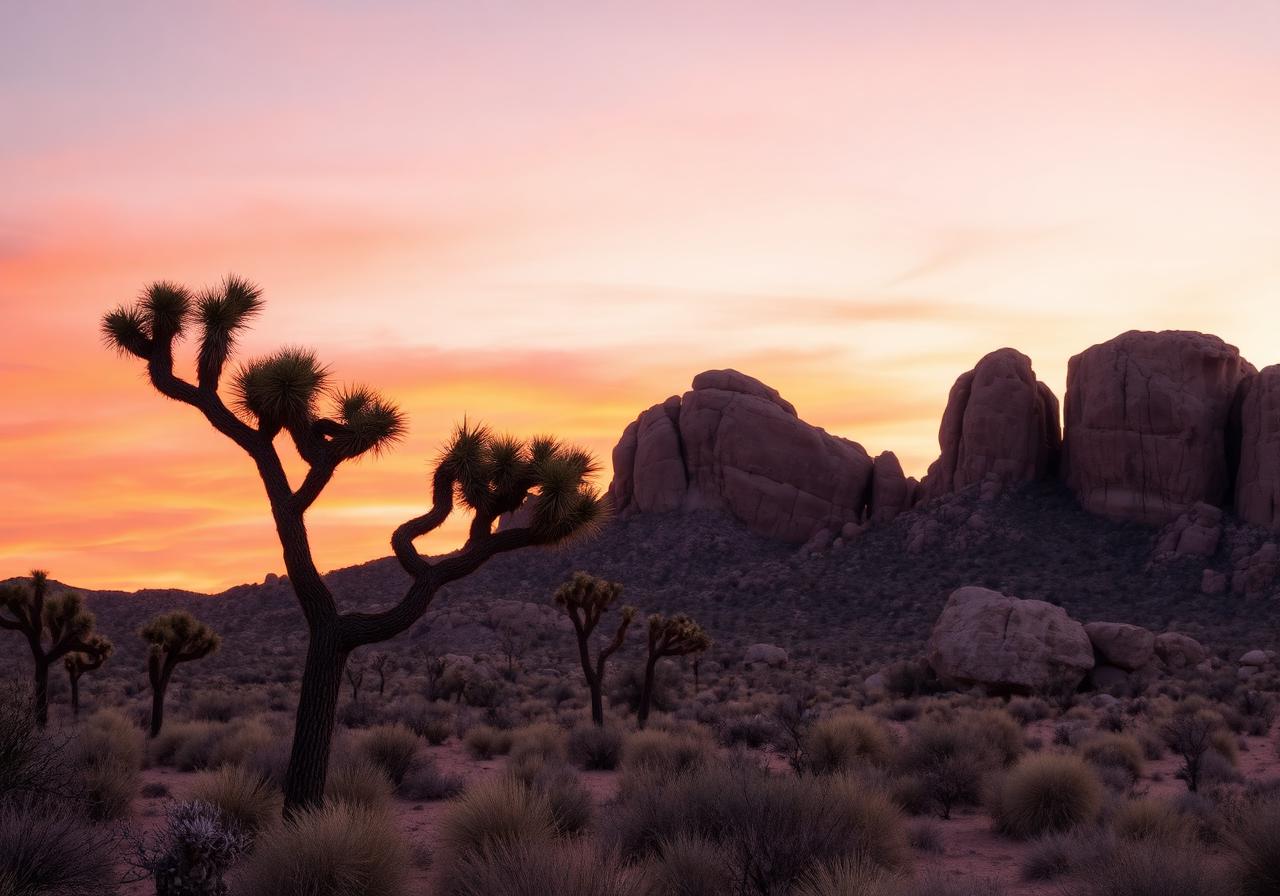
Where two deserts meet, the boulders climb themselves, and Gram Parsons is the local saint.
Joshua Tree National Park sits at the meeting of the Mojave (high) and Colorado (low) deserts — and the difference is visible to the eye. The park is full of monzogranite boulders, twisted Joshua trees, and a counterculture history that runs from Gram Parsons to U2 to Hipgnosis. This hunt mixes accessible park stops with the music history just outside the gates.
Pinch to zoom. Tap a marker to see the stop name. The dashed line traces the suggested walking order.
Each stop shows the walking distance and direction from the previous one, plus a tap-through to your phone's maps for step-by-step directions.
"Begin in the high desert. The mile loop circles a basin of monzogranite. Find the boulder shaped like a skull."
"A boulder with a flat cap, beside the road. Stand under the overhang. This is also the Gram Parsons memorial site."
"Beside the main park road, a boulder eroded into a skull. Walk the half-mile loop behind it."
"Drive to the top of the road. The view stretches a hundred miles. Find the relief map at the overlook."
"1.3-mile loop. Walk to the dam. If there's been rain, find the petroglyphs on the rock face."
"Drive south into the low Colorado Desert. Walk the boardwalk through 10 acres of teddy-bear cholla. DO NOT TOUCH."
"Just up the road. Find the spindly plants with red tips after rain."
"Drive south to the park's south entrance. Find the oasis with the date palms."
"Drive 30 min west out of the park. Walk Mane Street. Find the false-front saloon."
"Drive into the town of Joshua Tree. Walk the public courtyard. Find the small altar at Room 8."
"10 acres of assemblage sculpture in the high desert. Find the throne made of TV sets."
"End back where you began. Find a flat boulder. Watch the granite turn pink."